The cannabis root system (Cannabis sativa)
Anatomy, depth and functions of the hemp/cannabis root system: taproot, root hairs, rhizosphere and how living soil shapes CBD quality.
Beneath the CBD flower we harvest lies an invisible architecture that decides almost everything: the root system. In hemp (Cannabis sativa L.), the roots anchor the plant, take up water and minerals, store reserves and constantly negotiate with the life of the soil. Understanding how they are built, how deep they reach and what they need is the key to understanding a healthy plant — and, at the end of the chain, a quality flower.
Anatomy: taproot, lateral roots and root hairs
When hemp grows from seed, it develops a true taproot system:
- the cannabis taproot (main root) drives vertically down into the soil;
- lateral roots (secondary roots) branch off it and colonise the surrounding soil volume;
- those laterals are covered in root hairs (capillaries), microscopic extensions that absorb most of the water and minerals;
- at each growing tip, a root cap protects the apex as the root extends.
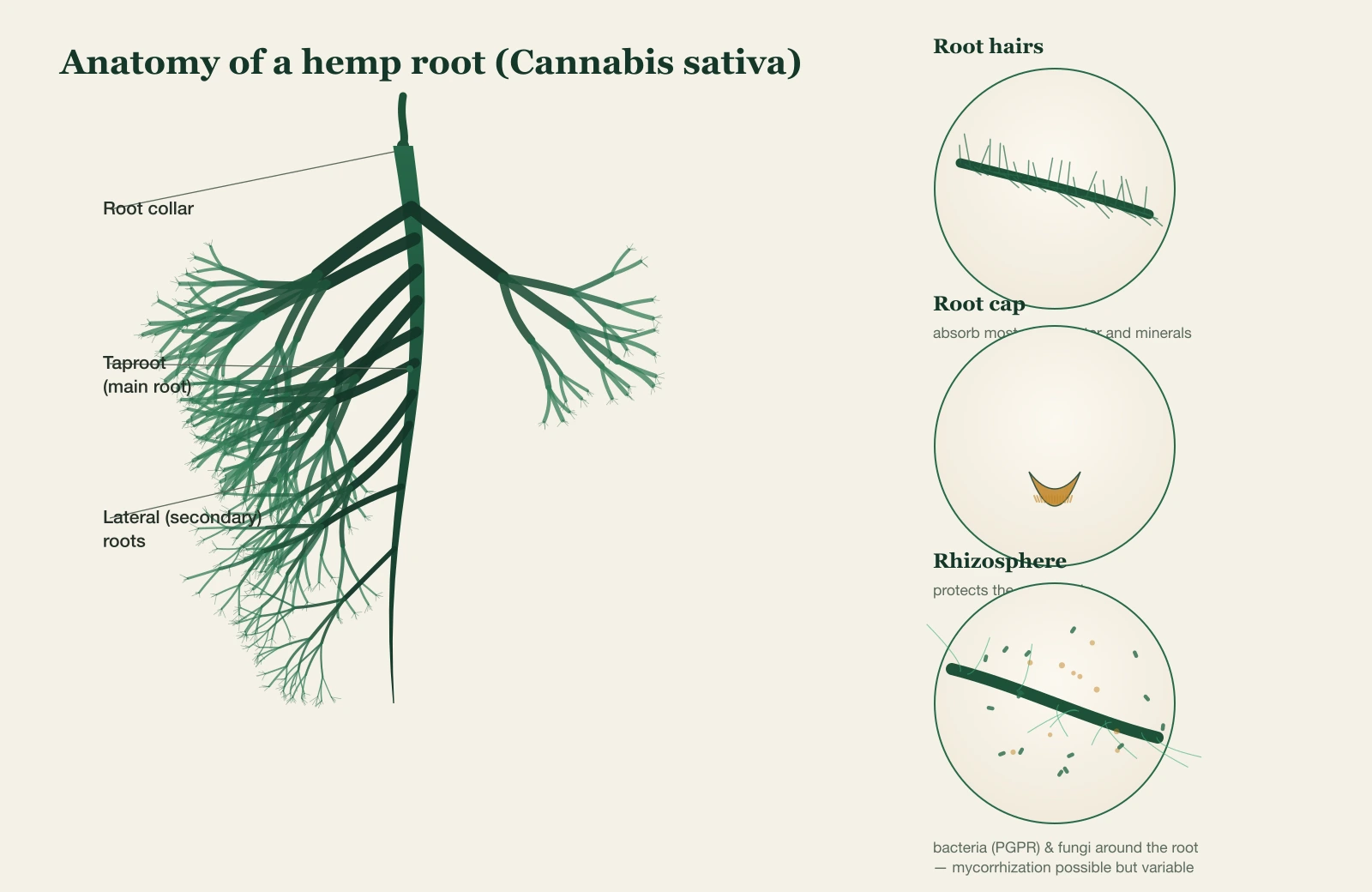
Anatomy of a hemp root, with close-ups of the root hairs, root cap and rhizosphere.
This structure is not always the same. A plant grown from a cutting (clone) forms no taproot: it develops adventitious roots from stem tissue, producing a more fibrous system without a dominant central root. That same ability to emit adventitious roots is why hemp is propagated by cuttings in professional nurseries — but the resulting architecture stays qualitatively different from a seed-grown plant.
What do hemp roots do?
Roots perform four vital functions:
- Anchorage: they hold the plant upright, which becomes critical late in flowering when the buds get heavy.
- Water and mineral uptake: the root hairs do most of this work; the denser the network of capillaries, the more efficient the absorption.
- Storage: roots stockpile water and nutrients the plant can draw on.
- Exchange and signalling: roots produce plant hormones and release exudates (sugars, organic acids) into the soil that feed and steer the microbial life around them.
A plant with an underdeveloped root system can neither feed itself properly nor support an abundant bloom: the root really is the foundation of everything else.
How the root system grows through the cycle
Most root expansion happens during the vegetative phase: this is when the plant builds its network of secondary roots and root hairs. Once it enters flowering, root growth slows markedly — the system is already in place and the plant's energy shifts toward the buds.
This timing matters: a root system damaged along the way (oxygen starvation, drying out) does not really "repair" itself. Lost root hairs are lost for good, which permanently reduces uptake capacity — and therefore yield. In other words, it is all decided early: healthy roots at the start of the cycle set up everything that follows.
How deep do cannabis roots grow?
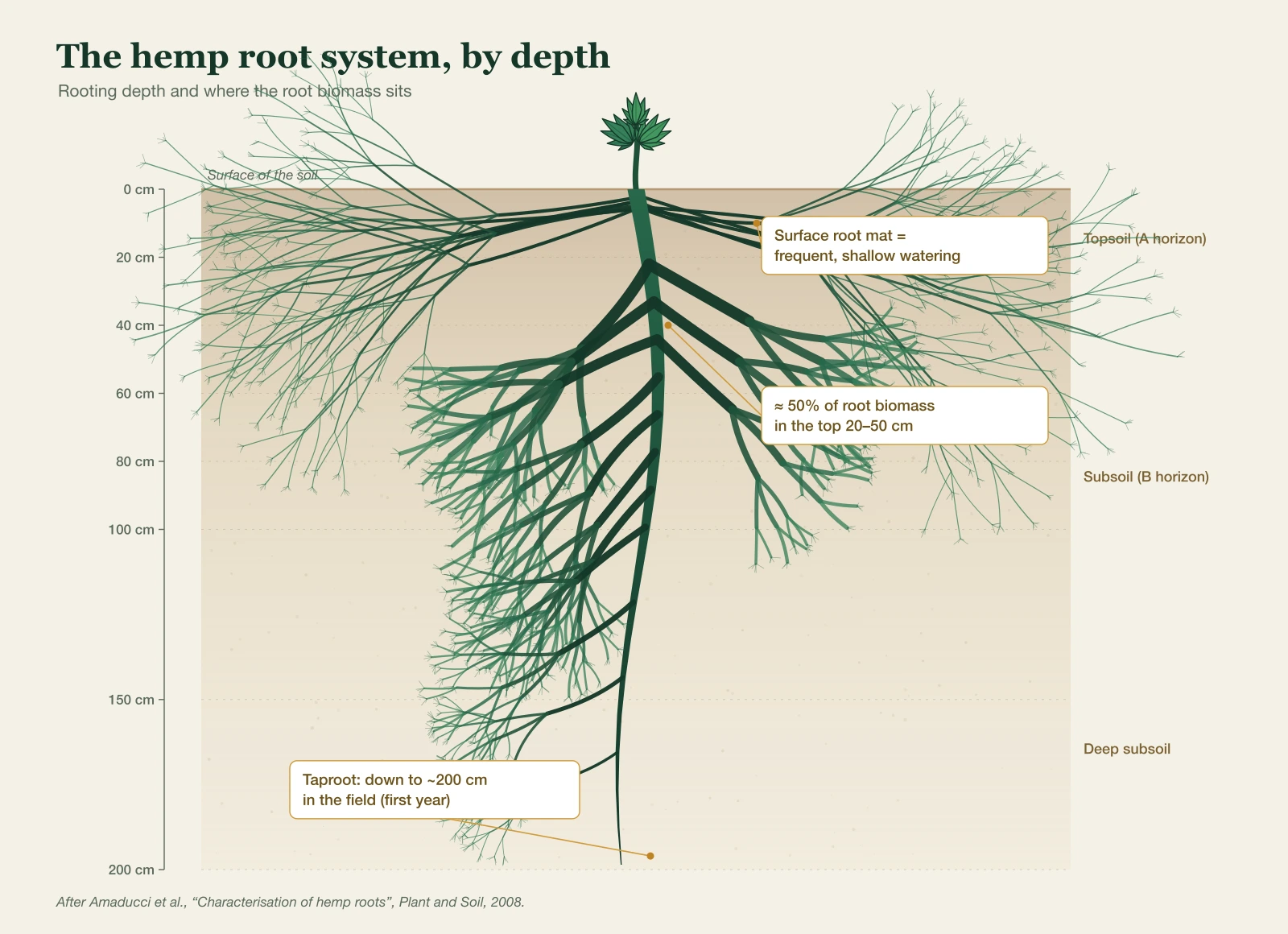
Rooting depth and distribution of root biomass in hemp (after Amaducci et al., 2008).
Much deeper than most people think. In the field, reference agronomic work has measured hemp roots reaching 130 cm in a single growing season, and up to about 200 cm under some conditions (Amaducci et al., 2008).
But depth is not where everything happens. The same study shows that:
- root length density peaks in the top 10 cm of soil;
- roughly half of the root biomass sits in the top 20–50 cm;
- root diameter increases with depth: fine and absorptive near the surface, thicker and more structural deeper down.
Notably, hemp invests more root biomass in deep soil layers than maize, wheat or sugar beet. This is part of why it is valued as a rotation crop and for its drought tolerance: it reaches water and nutrients where other crops do not.
That deep, dense rooting also leaves the soil better off. By opening channels through compacted layers and adding organic matter at depth, hemp improves soil structure and water infiltration — one reason it features in regenerative, low-till rotations, where the crop that follows it often benefits from the ground its roots have loosened.
Surface watering versus deep rooting
The root profile is not fixed — it adapts to how water arrives. One observes that frequent, shallow watering goes hand in hand with a surface root mat, the plant finding moisture at the top of the profile; conversely, deeper, less frequent watering goes with roots that grow downward to follow the moisture front. This is a well-established agronomic principle: a surface root mat is the sign of regular surface watering, not a defect in itself.
The same mechanism explains why a plant grown in a pot (limited volume, frequent watering) develops a shorter, branched system, while field-grown hemp builds a deep taproot in living soil — two very different root environments for two different plants, and one reason the choice between indoor, outdoor and greenhouse growing shapes the final flower.
The rhizosphere: soil life around the roots
Roots never live alone. The thin film of soil that surrounds them, the rhizosphere, is one of the most densely populated places on Earth: bacteria, fungi, archaea and micro-fauna thrive there, fed by root exudates.
And the plant is no passive party to this exchange: by releasing exudates (sugars, organic acids, chemical signals), the roots recruit and feed the micro-organisms that are useful to them. It is a genuine underground economy, in which the plant "pays" in carbon for the services soil life provides — nutrient access, protection, water retention.
Several of these microbes are beneficial:
- plant-growth-promoting rhizobacteria (PGPR) such as some Bacillus and Pseudomonas can colonise roots and stimulate the plant; a PGPR consortium increased hemp yield by nearly 70% in one study (Lyu et al., 2021);
- protective fungi (for example Trichoderma) can occupy space and limit pathogen establishment.
Mycorrhizae: what the science actually says
You often read that cannabis forms a powerful mycorrhizal symbiosis with fungi and that you should "always" add inoculants. The scientific reality is more nuanced:
- hemp can be colonised by arbuscular mycorrhizal fungi, but colonisation stays modest and variable (around 9–42% depending on the fungal species and soil);
- the benefit is not guaranteed: one study even recorded reduced growth in inoculated plants (Citterio et al., 2005);
- in the field, root-microbiome analysis found a dominance of Ascomycota (Fusarium, Mortierella) rather than mycorrhizal fungi (Ahmed et al., 2021).
Honest conclusion: hemp is a facultative, low-key mycorrhizal partner, not a textbook case of symbiosis. Soil microbial life matters enormously, but the shortcut "mycorrhizae = guaranteed big yield" is more sales pitch than evidence.
What healthy roots look like
A healthy root is white to cream, firm, well-branched, with a fresh, earthy smell. The most common warning signs:
- brown, mushy roots: usually root rot, caused by prolonged overwatering that starves roots of oxygen (anoxia). The culprits are mainly Pythium, Fusarium and Phytophthora, favoured by saturated, warm media (Punja & Rodriguez, 2018);
- dried-out roots: at the other extreme, prolonged drought kills the root hairs, and uptake capacity never fully recovers.
Silicon is often cited as an ally against these stresses: it is not an essential element but a beneficial one, depositing in cell walls and improving tolerance to drought and salt (Berni et al., 2021).
Preventing these imbalances comes down mostly to the state of the soil: an aerated, well-drained soil that does not suffocate the roots, together with active microbial life, naturally limits pathogen establishment. This is one advantage of living field soil over a saturated, inert medium — the roots find both the oxygen and the microbial allies they need.
Composition and historical uses of the roots
Unlike the flowers and leaves, roots contain virtually no cannabinoids (no meaningful THC or CBD). Instead they hold triterpenes (friedelin, epifriedelanol) and alkaloids.
That did not stop roots from being used for centuries: Pliny the Elder (77 AD), Dioscorides and traditional Chinese medicine all mention hemp-root preparations. These uses are a matter of history and research; they are noted here for documentary purposes only and constitute no health claim.
Roots, soil and the quality of French CBD
It all starts in the soil. A root system that spreads through living, field soil does not "build" the same plant as one confined in an inert substrate. In practice, this rests on choices that never appear on a label: covered, living soil, rotations that let hemp structure the earth, and measured irrigation that encourages the roots to go deep. Those patient, invisible agronomic decisions shape a plant's vigour long before harvest. This is one of the foundations of French farmer-grown hemp in short supply circuits: a terroir, a soil, a rooting — and then a flower that carries its imprint. It is also what ties the roots back to the long history of hemp in France, and to the same living soil that shapes the plant's terpenes.
Frequently asked questions
Do cannabis plants have a taproot? Yes, when grown from seed: they form a vertical taproot with lateral roots. Plants grown from cuttings have no taproot and develop a fibrous mass of adventitious roots.
How deep do cannabis roots grow? In the field, up to 130 cm in a single season and about 200 cm at most. Yet nearly half of the root biomass stays in the top 20–50 cm.
What is the difference between a taproot, fibrous roots and adventitious roots? A taproot is the single dominant root that grows down from a seed. Adventitious roots are roots that form from stem tissue rather than from an existing root — that is what cuttings develop. A fibrous (or fasciculate) system is a dense mass of similar-sized roots with no dominant central one, which is the form a clone ends up with.
What does the cannabis root system do for the plant? It anchors the plant, takes up water and minerals through the root hairs, stores reserves and exchanges signals with soil life (exudates, micro-organisms).
What do healthy cannabis roots look like? White to cream, firm, well-branched, with a fresh earthy smell. Brown, mushy roots usually signal overwatering and the onset of root rot.
Should you add mycorrhizae to cannabis? The science is mixed: hemp is colonised only modestly and variably, and the benefit is not guaranteed. Soil life is essential, but the claim that mycorrhizae ensure a big yield is not proven.
Do cannabis roots contain CBD or THC? No, not in any notable amount. They mainly contain triterpenes (friedelin, epifriedelanol) and alkaloids, not the cannabinoids found in the flowers.